How to read your CFE bill in Los Cabos
Locate the tariff and separate the bill components.
Mirasol · Los Cabos
These are two different anonymized services, both printed as tariff 1C. The first has a clear winter tier calculation. The second crosses into summer and shows why the current-period invoice can differ from the amount due.
Mirasol guide · Updated
Recreated learning copy. No account identifiers. This is not an official CFE bill or a solar quote.
Choose Edit amounts to highlight the inputs. Historical balances and old results disappear; the exercise calculates this period only.
Start when you are ready. You control the pace.
Recreated learning copy. No account identifiers. This is not an official CFE bill or a solar quote.
Choose Edit amounts to highlight the inputs. Historical balances and old results disappear; the exercise calculates this period only.
Start when you are ready. You control the pace.
The original PDF shows 1,241 kWh: 150 basic, 200 intermediate and 891 excess. The unit prices below are printed on that historical bill. We have not independently retrieved the matching monthly 1C publication, so these are documented bill rates, not a current nationwide price table.
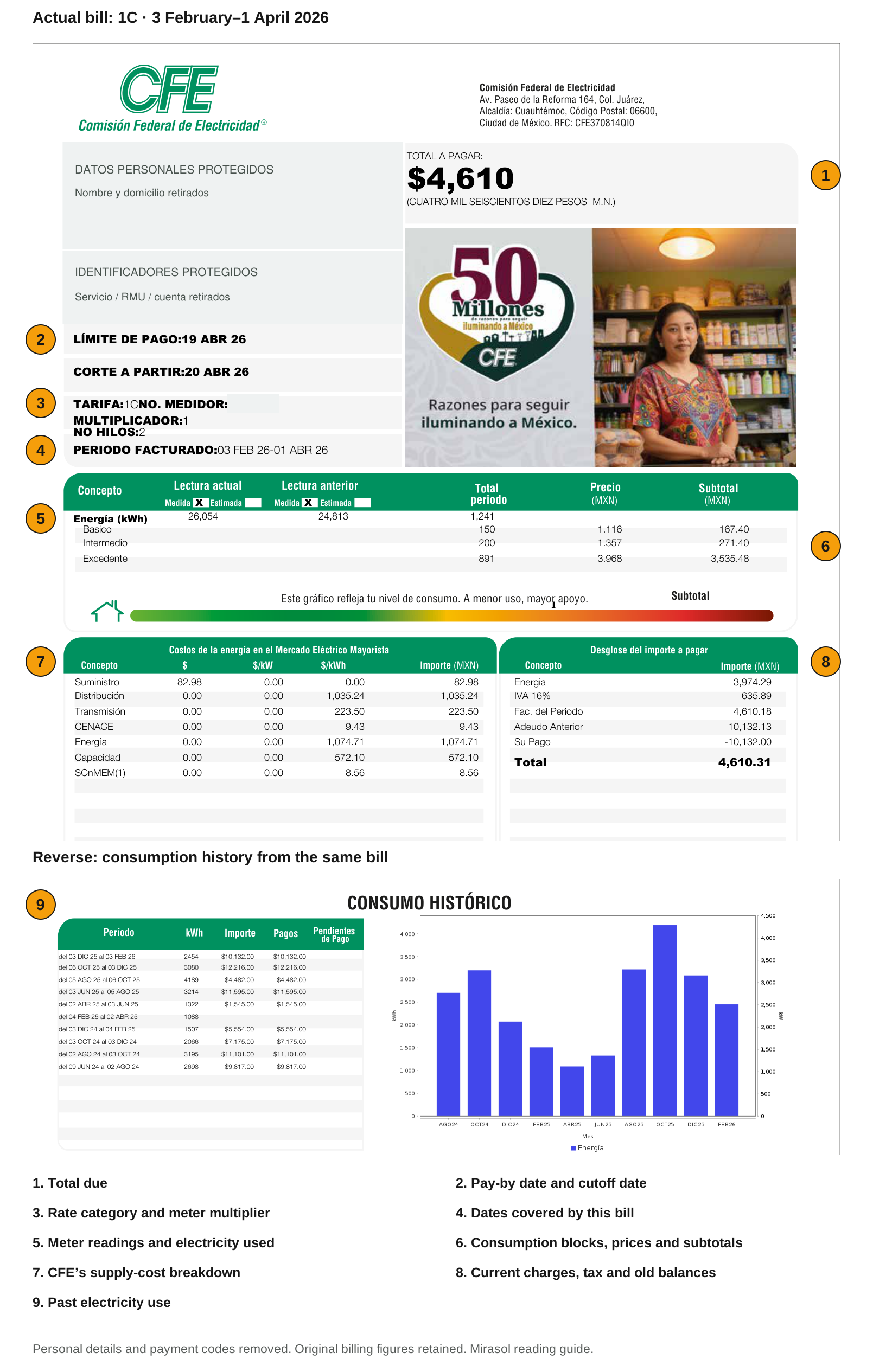
Match the numbered markers to the explanations below. The Spanish labels stay visible so you can find the same fields on your own bill. Tap or click the bill to enlarge it.
Open the labeled bill at full size ↗
TOTAL A PAGAR
This is the amount CFE asks you to pay. The front rounds it to $4,610 MXN; the detailed total is $4,610.31. It includes the remaining balance from the previous bill.
LÍMITE DE PAGO / CORTE A PARTIR
Pay by 19 April 2026. The next line says service may be cut from 20 April. These dates are separate from the dates of electricity use below.
TARIFA / MULTIPLICADOR
This service is printed as tariff 1C, with multiplier 1. That determines which rate rules to check. A high peso amount alone does not mean the service is on DAC; read your own TARIFA field.
PERIODO FACTURADO
03 FEB 26–01 ABR 26 means 3 February–1 April 2026. The 1,241 kWh below belongs to this whole period. Do not compare it directly with a one-month solar payment.
LECTURA ACTUAL / LECTURA ANTERIOR / TOTAL PERIODO
The meter went from 24,813 to 26,054. Subtract the readings and apply multiplier 1: 1,241 kWh used. kWh measures electricity; it is not a peso amount. The X marks measured readings on this bill.
BÁSICO / INTERMEDIO / EXCEDENTE · PRECIO / SUBTOTAL
CFE splits these 1,241 kWh into 150 basic, 200 intermediate and 891 excess. PRECIO is MXN per kWh; SUBTOTAL is the charge for that row. These are this historical winter bill’s rates, not today’s prices for every home.
COSTOS DE LA ENERGÍA EN EL MERCADO ELÉCTRICO MAYORISTA
The left-hand box explains supply, distribution, transmission and other energy-market costs. Do not add this box again to the right-hand payment breakdown; that would double count the bill.
DESGLOSE DEL IMPORTE A PAGAR
ENERGÍA is $3,974.29 and IVA is $635.89. FAC. DEL PERIODO is their $4,610.18 invoice. ADEUDO ANTERIOR means previous balance; SU PAGO means your payment. $10,132.13 − $10,132.00 leaves $0.13, bringing the account total to $4,610.31.
CONSUMO HISTÓRICO
On the reverse, each row is a previous billing period. kWh is electricity, IMPORTE is the bill amount, PAGOS is payments and PENDIENTES DE PAGO is unpaid balance. The blue bars show kWh. Use dated rows to compare seasons; these bars alone do not prove when DAC began.
Field definitions: Puebla Energy Agency — understand your CFE bill (Spanish). The figures shown here come from this bill; the reference is used for field meanings, not BCS prices.
| Tier / Bloque | kWh | MXN/kWh | Product / Producto (MXN) |
|---|---|---|---|
| Basic / Básico | 150 | 1.116 | 167.400 |
| Intermediate / Intermedio | 200 | 1.357 | 271.400 |
| Excess / Excedente | 891 | 3.968 | 3,535.488 |
| Energy total / Energía total | 1,241 | — | 3,974.288 → 3,974.29 |
The products sum to 3,974.288, displayed as 3,974.29. IVA is 635.89 and the period invoice is 4,610.18. A previous balance of 10,132.13 less a payment of 10,132.00 adds 0.13: the account total is 4,610.31. One printed tier subtotal shows 3,535.48, a cent below rounding its displayed product independently. We preserve that discrepancy rather than change the source; the full-precision aggregate reproduces the energy total.
The supplied photo covers 1 April–3 June 2026 and records 1,471 kWh. CFE divides the table into 29 days outside summer and 34 summer days, with different blocks. Using one winter or summer rate for all 1,471 kWh would miss that split. The photo is too small to verify every fractional allocation and tier subtotal to the cent, so we do not claim an independent reconstruction of its 4,035.68 energy charge.
The payment breakdown is clear enough to reconcile exactly. Reconnection is separate from energy. Government support is an explicit line on this particular document; it is not an assumed universal discount. The 0.66 remaining from the prior balance is not current electricity consumption.
| Line | Amount |
|---|---|
| Energy | 4,035.68 |
| Reconnection | +78.45 |
| Taxable subtotal | 4,114.13 |
| IVA 16% | +658.26 |
| Current-period invoice | 4,772.39 |
| Government support shown | −720.73 |
| Subtotal after support | 4,051.66 |
| Previous balance | +4,076.66 |
| Payment | −4,076.00 |
| Account total | 4,052.32 |
Use the tariff actually printed on the service, its billing dates, seasonal blocks and full annual consumption. Removing kWh changes the tier calculation; multiplying all solar production by the average amount-due per kWh can overstate savings. Reconnection, payments and past debt belong outside an energy-only comparison. One high bill does not establish DAC: that classification uses the rolling 12-month average and the appropriate domestic limit.
Locate the tariff and separate the bill components.
Work through a full-year DAC example.
If the service is on DAC, use annual kWh and daytime use to compare system sizes.
FAQ
A period crossing a seasonal boundary can show separate summer and non-summer allocations. The April–June example explicitly prints both day counts; do not apply just one set to the whole period.
No. That amount is transcribed from this specific bill. Do not reuse it for another service, period or tariff.
The winter products reproduce its energy total and account total. For the summer-transition photo, the clear payment lines reconcile exactly, but a sharper original is needed to verify every tier allocation. Historical rates and the billing system’s precision rules also need separate confirmation.
Sources
These references provide technical context. Your location, energy needs and project scope still need an individual assessment.
Ready to start?
Use your CFE bill for an initial assessment. Roof conditions, equipment and the final scope need confirmation before installation.